



Kino Lumbardhi will close at the beginning of June and will enter the renovation process. The long process we went through to secure an agreement for the closure of the Kino Lumbardhi building, opened in 1952 and since then, has undergone a multitude of transformations and uses as a cinema, cultural space and place for socializing, culminating in the agreement with the Ministry of Culture, Youth and Sports of the Republic of Kosovo.
Since 2015, after great efforts by the cultural and artistic community in Kosovo, the region and around to stop the process of privatization and dismantling of this historic and iconic building in the city of Prizren, the Lumbardhi Foundation has operated in the space with the aim of reviving the tradition of watching films and creating new moments for culture and socializing.
On the occasion of the closure of the physical cinema building, the Lumbardhi Foundation has prepared a 4-day program, on May 25, 28, 30 and 31, to meet for the last time in this space, which will change from June. The closing week program includes film screenings, music concerts and meetings with the community to say goodbye to this space as we know it and to give a good omen for its future chapters.
PROGRAM
25.05 20:30
Film Screening - Beynelmilel (The International) directed by Sırrı Süreyya Önder, Muharrem Gülmez - Kino Bahce
28.05 20:30
Film Screening - Una vida util (A useful life) directed by Federico Veiroy - Kino Bahce
30.05 20:30
Concert: Baba Zula and Gipsy Groove
Tickets: 10 euros. You can only get them at Kino Lumbardhi in Prizren or by sending us a DM on Instagram / email at info@lumbardhi.org
31.05
18:00 - Closing Ceremony (only by invitation)
19:00 - Film Screening - Por primera vez (For the first time) directed by Octavio Cortazar; Lampa cu caciula (The tube with a hat) directed by Radu Jude; Prizrenski Motivi (Prizren Motifs) directed by Živorad 'Žika' Mitrović.
20:00 - Reception
20:00 - Erteller Dj Set/ Esma and Murat Ertel

Our four residents of the OPE.N program in Prizren: Antonela Solenički, Francisco Tomsich, Maja Bojanić and Una Štalcar-Furač are towards the end of their five-week stay, and next week on April 18th, we invite you all to be part of the final presentations of their works.
Not In The Forecast explores how artists appropriate, repurpose, and ‘steal’ – whether materials, spaces, or narratives – to construct meaning and navigate instability. The exhibition gestures toward cultural survival as a strategy of adaptation and remaking within shifting contexts.
The residency program is supported by OPE.N project and is co-financed by the European Union.
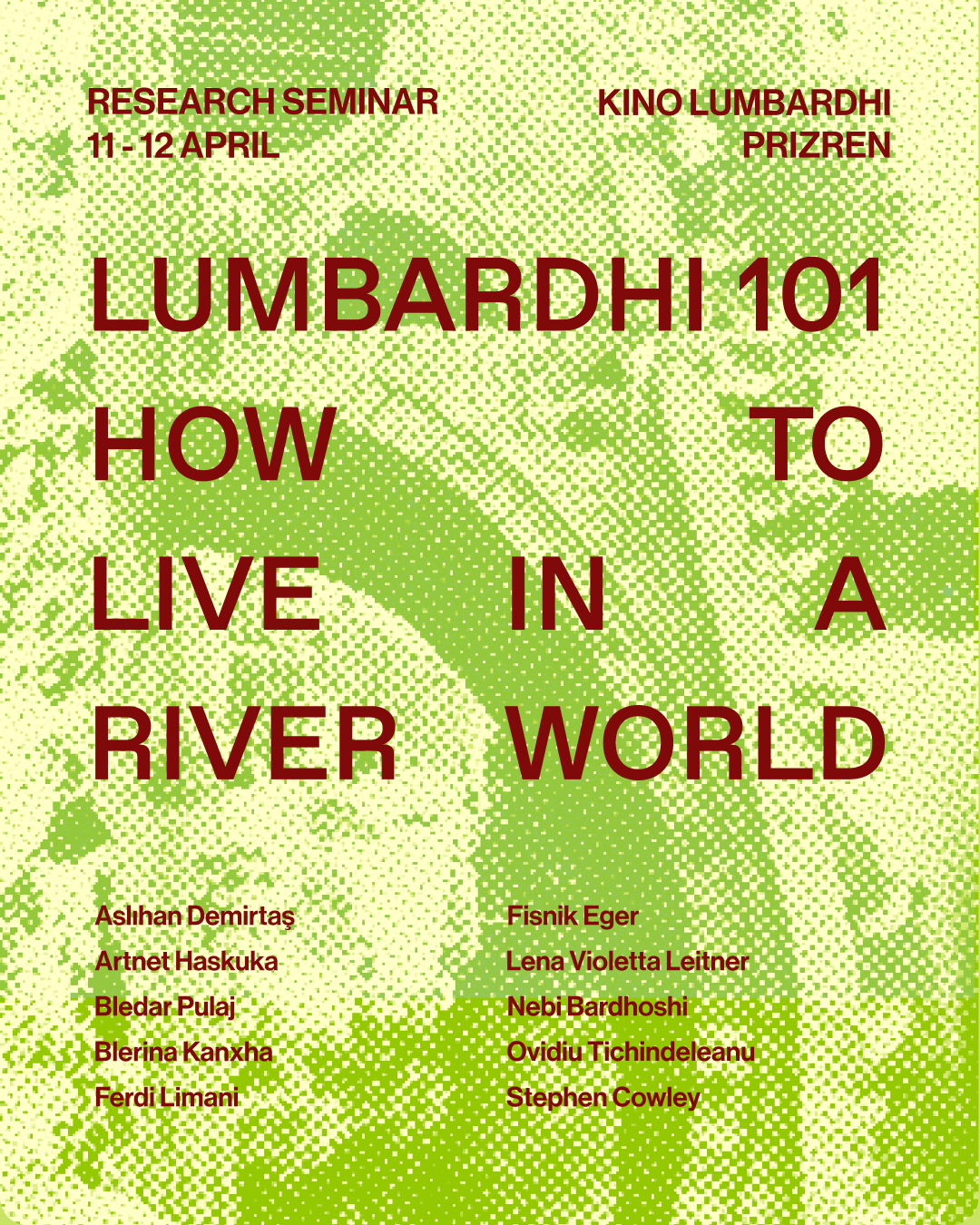
Lumbardhi 101 is an exploratory seminar that focuses on the Lumbardhi River, a vital yet increasingly overlooked lifeline of Prizren.
Once central to the city’s social, cultural, and ecological fabric, the river teemed with fish, birds, and swimmers, powered the city with electricity, sustained over 40 mills and passed through gardens and streets, being an essential part of urban life and collective memory.
In the later part of the last century, in response to the interventions to its structure, it destroyed the iconic Stone Bridge, and became an outcast, further disconnected from society.
Although celebrated and put back into touch through the city’s festivals and biennial, nowadays it’s a moving repository of toxic waste, as its biodiversityhas declined, its accessibility has diminished, and its role in day-to-day city life has faded.
This seminar seeks to bring attention to Lumbardhi and think of it as a common—not just a resource but a space of memory, connection, and possible ecological regeneration.
Bringing together thinkers and practitioners from fields such as ecology, anthropology, ecolinguistics, architecture, urbanism and arts, it aims to assemble and exchange knowledge, share initial findings of new research, exploring perspectives of water heritage, infrastructure, biology, language, and urban life to spark new ways of thinking about and living with the river.
Through research, dialogue, and shared experiences, it aims to reconnect human and non-human inhabitants to Lumbardhi’s waters and imagine its possible future.
APRIL 11 SCHEDULE
10:15 - Introduction and Opening Remarks by Ares Shporta
10:30 - 11:15 - Ecolinguistic prospects for the Prizren place-world by Stephen Cowley
11:25 - 11:40 - Languaging and the River Initiative - A field report by Fisnik Eger
11:40 - 12:20 - On the Presence of the Lumbardh River in the Life of the City by Nebi Bardhoshi
12:25 - 12:50 - A photographic investigation of Lumbardhi River by Ferdi Limani
14:00 - 14:40 - Prizren Region - A Crossroads of Biodiversity, Culture and Heritage
by Bledar Pulaj
14:50 - 15:20 - Lumbardhi and urban transformation by Artnet Haskuka
15:30 - 16:00 Inside Bekim Fehmiu’s Bistrica by Blerina Kanxha
APRIL 12 SCHEDULE
10:00 - 10:40 - Grafted Lakescapes: Modern Dams on Ageless Rivers by Aslıhan Demirtaş
10:50 - 11:30 - Non-Western Technologies for the Good Life by Ovidiu Tichindeleanu
11:40 - 12:20 - Danube Transformation Agency for Agency by Lena Violetta Leitner
13:30 - 15:30 - Reflection Forum
LECTURERS
STEPHEN COWLEY
Stephen Cowley, Professor Emeritus at the University of Southern Denmark. His career has taken him to Italy, Sweden, the former Yugoslavia, South Africa, the United Kingdom and Denmark.
During the memorable years 1982-1984, he taught in Prizren. While he tried to learn Albanian, but failed with the Gheg and Prizren Turkish, he continued this linguistic journey towards uncharted questions. This research led him to rapid and interdisciplinary views of language, to the mind and, of course, to how being fits into life itself.
FISNIK EGER
Fisnik Egër is a Psychology graduate interested in culture and research. As part of the Lumbardhi Foundation, he has worked under Stephen Cowley's mentorship to explore how language influences our perception and relationship with the river.
NEBI BARDHOSHI
Bardhoshi is senior researcher in socio-cultural anthropology, with specific research interests in legal and political anthropology, the anthropology of nature, and the history of anthropological thought.
Bardhoshi is the author of several books including “The Border Stones: The Kanun, Property, Social Structuring” (2011), “Anthropology of the Kanun” (2015), and “Ethnography in Dictatorship: Knowledge, the State, Our Holocaust” (2018, co-authored). He has also published numerous academic articles and served as editor of various volumes on Albanian society as well as the broader Balkan and Mediterranean region.
FERDI LIMANI
Ferdi began his photography career while working as an assistant for foreign photojournalists. Driven by a deep sense of justice and anger, as a teenager he picked up a camera to document the atrocities committed against his people.
This passion led him to study journalism and work with local and international media. In 2008, after being selected to document Kosovo’s declaration of independence, he left the country, continuing his work as a photojournalist in France and then in Turkey and Syria. After returning to Kosovo, he is focused on creating a substantial photographic archive of a rapidly changing Kosovar and Balkan society.
BLEDAR PULAJ
Bledar Pulaj, born and raised in Prizren, is a biologist, university teaching assistant, and PhD candidate, specialized in plant ecology, plant phylogeny, phytochemistry, ethnobotany and biodiversity conservation.
With over a decade of academic, research, and project experience, he is author and coauthor of numerous scientific publications and contributed to biodiversity and conservation initiatives across Kosovo and the Balkans.
ARTNET HASKUKA
Artnet Haskuka is an architect, urbanist and heritage professional, who is the founding director of STOP Institute. With academic and professional background in Architecture and Urban and Environmental Management, she has extensive experience in place-making, heritage management, disaster risk management and climate change action planning and reconstruction and heritage restoration, working with institutions such as the UN-Habitat, Ministry of Culture, Youth and Sport and UNDP, among others.
In the last decade she has acted as member of Council for the Cultural Heritage of the Historical Center of Prizren, and contributed to many local and central bodies related to heritage and sustainable urban development.
BLERINA KANXHA
Blerina Kanxha studied Albanian Language and Literature at the University of Tirana and Semiotics at the University of Bologna. She has worked in the communication field for years, focusing on contemporary art, youth engagement, and exhibition curation in Albania and Kosovo. Now she is engaged as the Communications and Program Associate at Lumbardhi Foundation in Prizren.
ASLIHAN DEMIRTAŞ
Aslıhan Demirtaş is the founder of KHORA Office, an expanded architectural practice focused on research, art, and ecology, originally established in New York and now based in Istanbul.
Parallel to her architectural practice, she often teaches and is currently working on her book Graft to be published by Salt with support from the Graham Foundation.
OVIDIU TICHINDELEANU
Romanian philosopher, translator and culture theorist, writing on critical social theory, the history and philosophy of senses, decolonial thought, alternative epistemologies, artistic practices and cultural history.
Editor of IDEA arts + society and member of the editorial board of L’Internationale Online. Member of the artist-run cooperative The Experimental Research Station for Art and Life. Recent article: “Building an Ecological Art Institution”, with Raluca Voinea, in Art for Radical Ecologies, IRI 2024.
LENA VIOLETTA LEITNER
Lena Violetta Leitner is one of the co-founders of DTAFA.
She completed her studies in Digital Arts at the University of Applied Arts Vienna (AT). Currently, she is an artist in residence at Foundation17 in Pristina (awarded by the Province of Styria), seeking to uncover the stories of the buried rivers of the city.
Stop-motion animation is a fun and creative way to tell stories using simple tools like a smartphone and everyday objects. In this workshop, participants will learn the basics of stop-motion, from frame-by-frame movement to adding sound and finalizing their own short animations.
The session will begin with an introduction and an icebreaker activity to set a collaborative tone. Participants will watch examples of famous stop-motion films, student projects, and an original short by the instructor. A discussion on archives will provide inspiration for storytelling, exploring themes of memory and creativity.
Next, participants will be introduced to the free Stop Motion Studio app, learning how to capture movement, edit sequences, and refine their videos. The main part of the workshop will focus on hands-on practice, where small groups will develop stories and bring them to life through animation. Towards the end, they will add sound to their projects before a final screening. The workshop will conclude with a Q&A and discussion.
Open to all skill levels, this workshop is an opportunity to experiment, collaborate, and explore the magic of stop-motion storytelling.
About the instructor:
Leah Clare Michaels is a Baltimore native, artist, activist, historian, writer, and surfer. She has produced documentary films, multi-media installations, and performance art works rooted in historical research, social justice, and cultural exchange.
She received a B.A. in History with a focus in Classics from the University of Washington in Seattle in 2012 and a M.F.A. in Intermedia and Digital Arts from the University of Maryland, Baltimore County (UMBC) in 2019.
Michaels has taught and presented in the United States, Europe, and Asia including an international tour of her feature documentary Rock, Rage & Self-Defense: An Oral History of Seattle’s Home Alive, which she co-directed and produced with friend and colleague Rozz Therrien. Her written work has appeared in BmoreArt, UMBC Magazine, and the Debutante Journal based in Edinburgh, Scotland. She teaches film, media art, and cinema studies at Towson University and Anne Arundel Community College. She was awarded a Fulbright grant to Poland for the 2023-2024 academic year.
Date & Time: March 22nd
Location: Kino Lumbardhi, Prizren
Deadline to Apply: March 20th
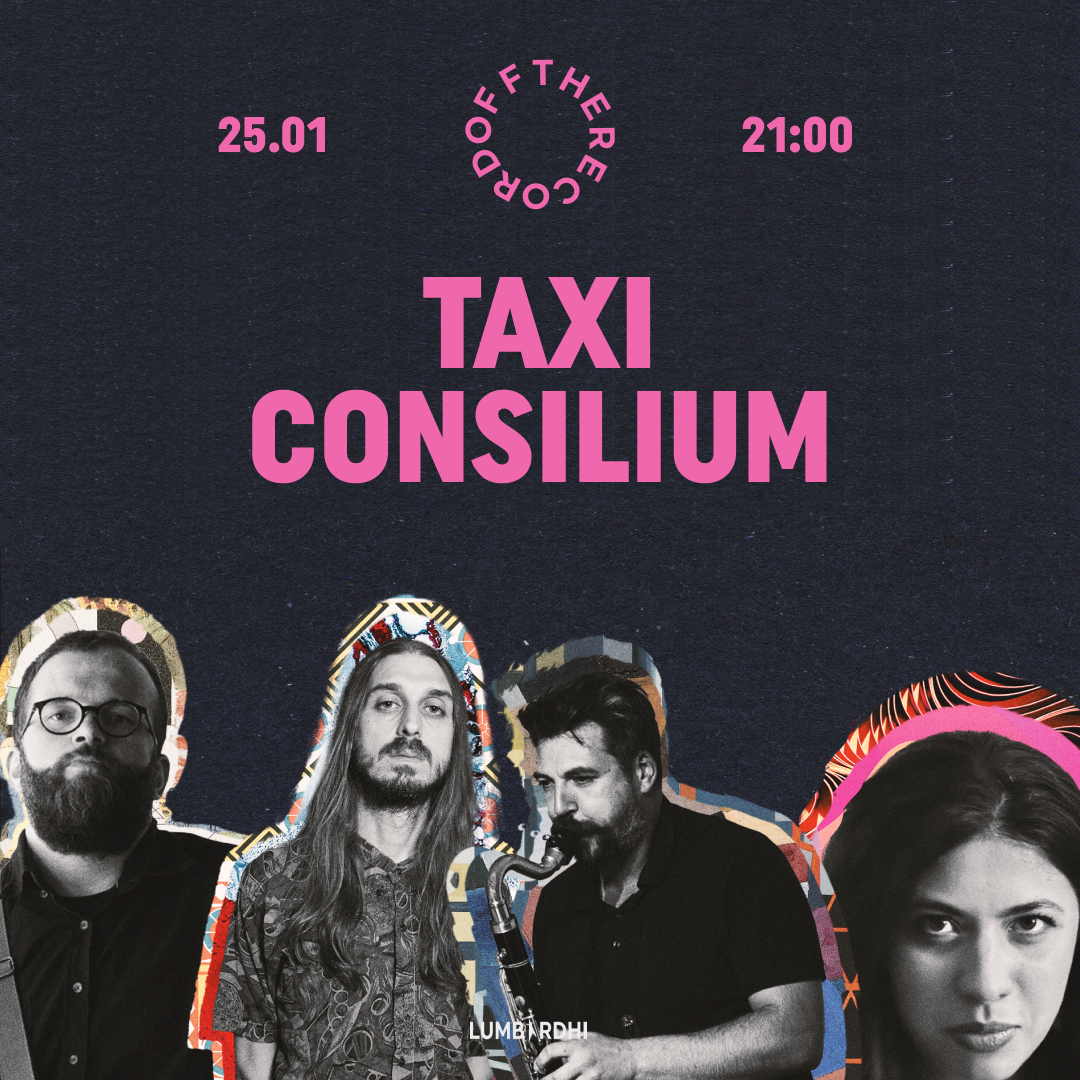
The Taxi Consilium quartet with Dragan Todosiev on drums, Filip Bukrshliev on guitar, Blagojche Tomevski on clarinet and Andre Mircheska on double bass, are known for their lively interpretations on the jazz scene in North Macedonia, especially for the special fusion of traditional and modern elements, recreating a distinctive and dark sound and with performances send audiences in very special journeys.
Guided by the wisdom of taxi drivers who travel late at night, their music offers a space of light for the lives of people who are often unnoticed, but who live with great spirit, with rebellion even in routine, in illegality, in the dark and shady alleys.
We welcome you all next Saturday to listen together to Taxi Consilium, Off the Record music session at Kino Lumbardhi.

On January 23, we invite you all to the lecture “On River Culture” by anthropologist and researcher Nebi Bardhoshi at Kino Lumbardhi. Three rivers: Valbona, Zall-Gjoçaj and Vjosa, build a life of their own by weighing and building an unique order to the social and cultural organization nearby them whether through mythology or natural phenomena that live or with interactions with people, it seems that rivers do not only lead a life of their own. Nebi Bardhoshi's analysis puts these three rivers in communication and together they bring a panorama of what we can call river culture.
Bardhoshi is senior researcher in socio-cultural anthropology, with specific research interests in legal and political anthropology, the anthropology of nature, and the history of anthropological thought. Bardhoshi is the author of several books including “The Border Stones: The Kanun, Property, Social Structuring” (2011), “Anthropology of the Kanun” (2015), and “Ethnography in Dictatorship: Knowledge, the State, Our Holocaust” (2018, co-authored).
He has also published numerous academic articles and served as editor of various volumes on Albanian society as well as the broader Balkan and Mediterranean region.
This is the fourth presentation of the series of lectures organized for the "Permanent Transition" project supported by the European Cultural Foundation.
This program brings together a multitude of researchers and professionals and practitioners from the fields of art, linguistics, activism, economy and other fields, with the aim of proposing different ways of understanding the climate crisis and how we can respond in the future.
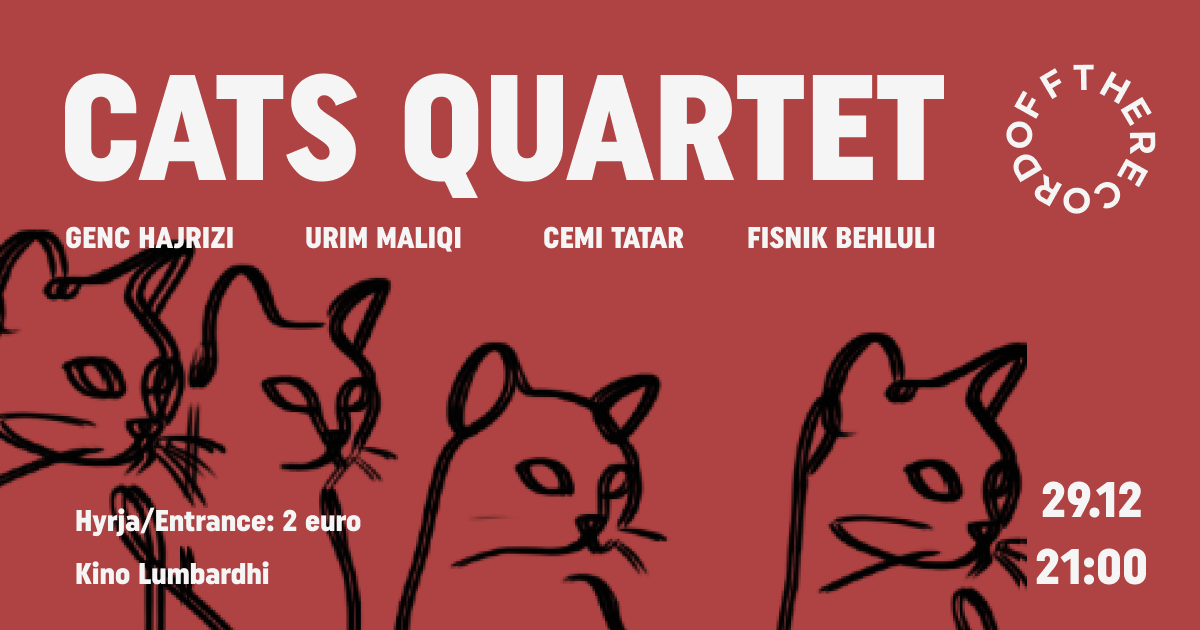
Off the Record music program, on its second year has brought many performances at the indoor space of Kino Lumbardhi and now it is time we welcome you all to the last concert for this year.
2024 has gone pretty quickly, yet we have one last show for you: Cats Quartet, Kosovo's own group of skilled musicians who are in love with jazz and innovation, will come to Kino Lumbardhi on the Dec. 29th starting from 21:00.
Cats Quartet is a jazz band that brings a unique combination of modern and classical, playing in innovative forms and bringing a completely youthful energy. Fisnik Behlulin (trumpet), Urim Maliqi (electric guitar), Genc Hajziri (keyboard) and Cemi Tatar (drums) will make sure to wrap up this year in style at our favourite spot in Prizren.
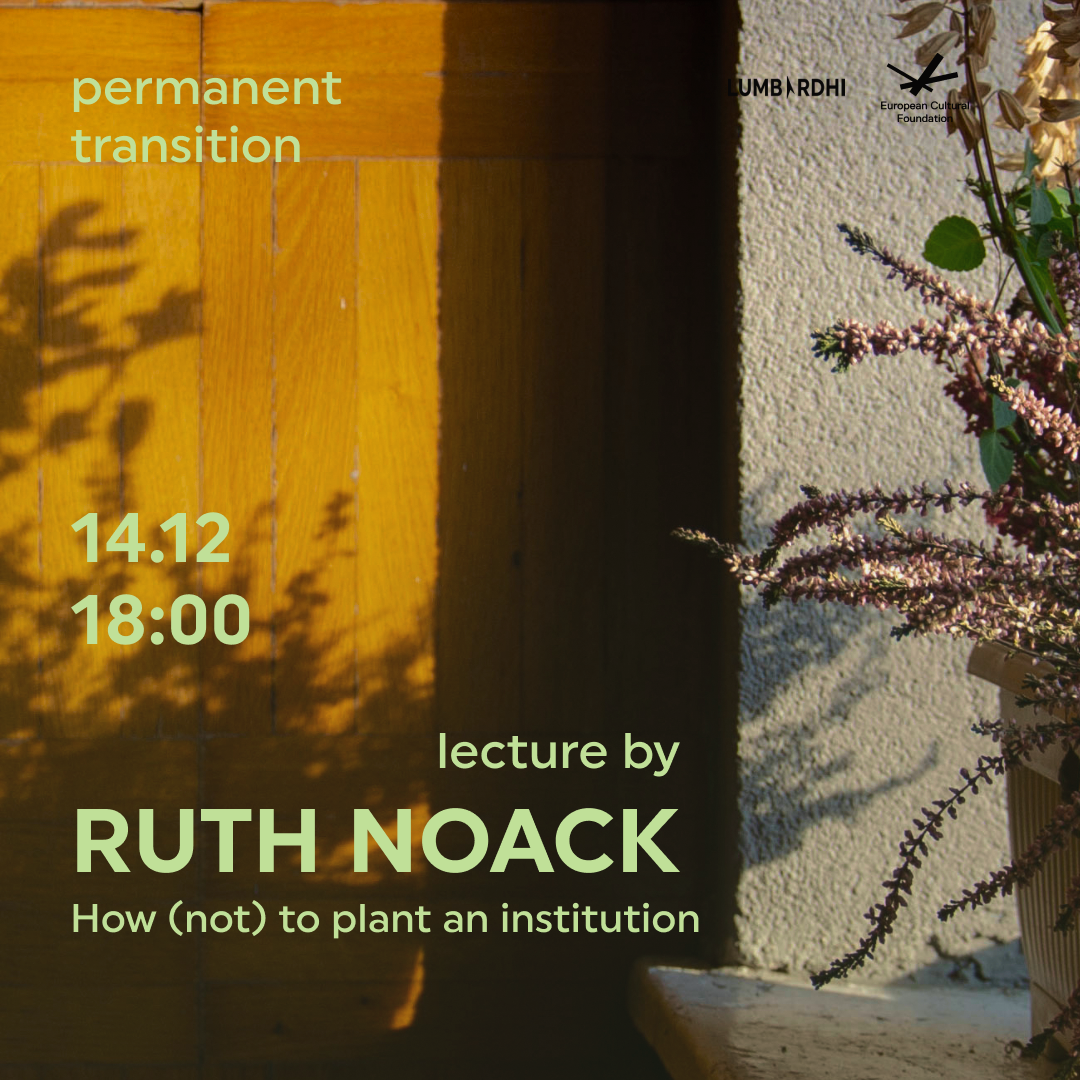
On December 14,s tarting from 18:00, we welcome you all to a lecture with Ruth Noack to Kino Lumbardhi as part of the Permanent Transition program.
How (not) to plant an institution
Ruth Noack’s lecture will focus on her experience in envisioning The Corner at Whitman Walker, a cultural institution in Washington D.C. that operated during the pandemic years, only to close its activity in 2021 due to financial issues. Noack was invited to propose a guideline for the organization of this institution but instead she opted for a garden map instead of a roadmap to fulfill its conception. Despite the institution’s longevity, this experience offered a possibility in searching for more relevant and enriching ways to better understand the meeting points between art and life.
Ruth Noack is an art historian, curator, educator, and writer best known for her work as curator of the 12th edition of documenta. Among other things, she has held the position of Executive Director of The Corner at the Whitman Walker in Washington D. C. and has curated numerous exhibitions at museums and contemporary art institutions. She has been and is engaged as a lecturer in universities and academies for over 20 years including 4 years at the Dutch Art Institute and guest professorships (AVU, Prague; Städelschule in Frankfurt). She has held the position of Head of Curating Contemporary Art at Royal College in London, and is the author of over 50 essays on contemporary art, including a monograph on the work of Sanja Iveković.
This is the third presentation in a series of lectures organized for the “Permanent Transition” project supported by the European Cultural Foundation.
This program brings together a variety of researchers and professionals and practitioners from the fields of art, linguistics, activism, economics and other fields, with the aim of proposing different ways of understanding the climate crisis and how we can respond in the future.
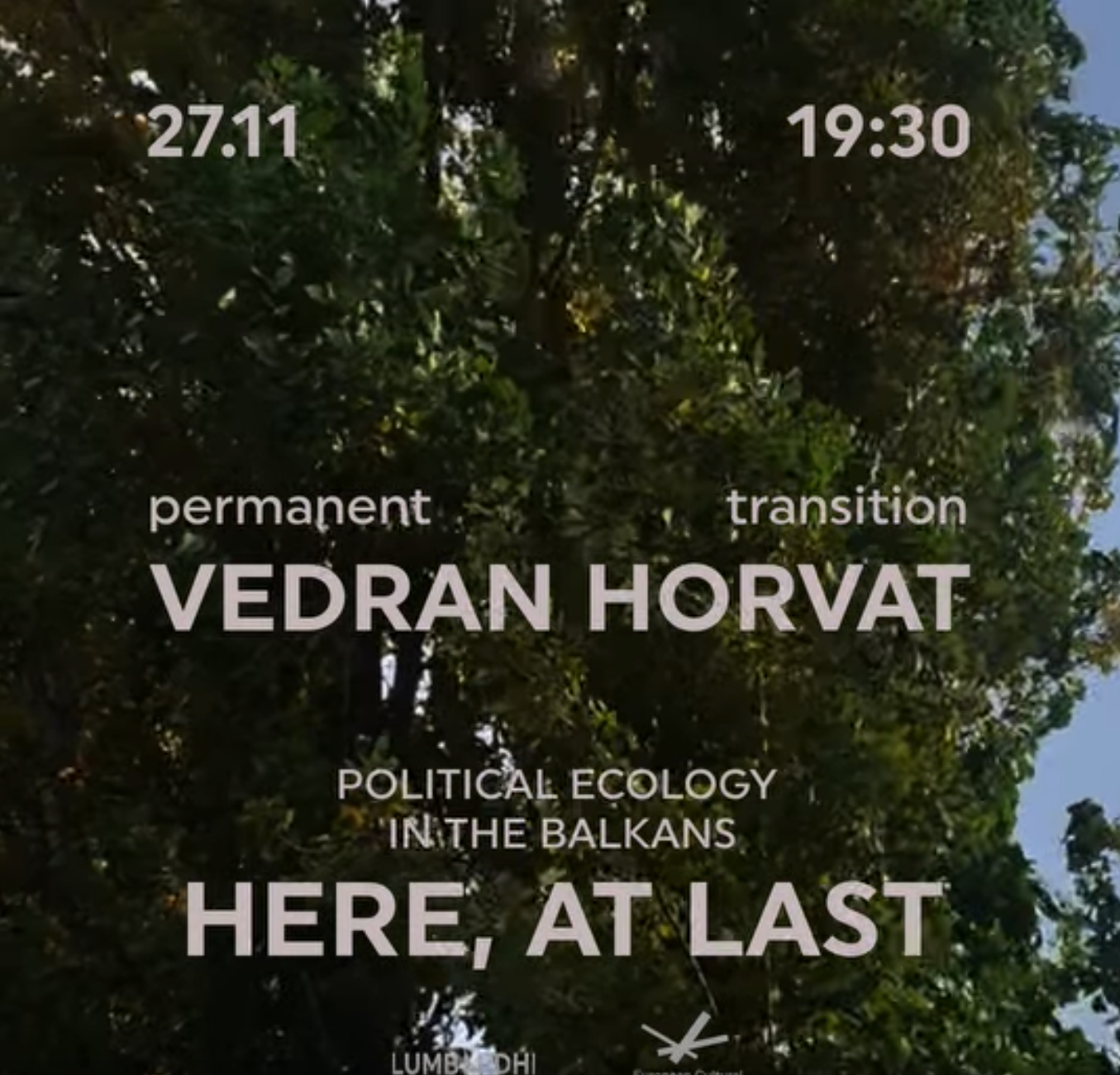
Lecture by Vedran Horvat on ecological politics in the Balkans.
Vedran Horvat will be at Kino Lumbardhi on November 27, from 7:30 p.m. to discuss ecological policies in the Balkans informed by his work as the head of the Institute for Political Ecology and his latest book "Here at last - Pathways to Green Politics in the Balkans". In the book he deals with the importance of green policies and their role in the Western Balkans under the magnifying glass of the return of authoritarianism, the erosion of democracy and environmental degradation, seeing these policies as key to being positive transformative agents of the future.
Vedran Horvat is a former journalist, sociologist, researcher, activist and author. Since 2015 he has worked as head of the Zagreb based Institute for Political Ecology. In the last two decades he has been on numerous occasions involved in environmental struggles, municipalist initiatives and green political projects in Croatia, in the Balkans and Europe. As founder and key coordinator of Green Academy, an advanced program of education in political ecology, he has been operating in the nexus between politics, academia and social movements.
More about the program:
This is the second presentation of the series of lectures organized for the "Permanent Transition" project supported by the European Cultural Foundation.
This program brings together a multitude of researchers and professionals and practitioners from the fields of art, linguistics, activism, economy and other fields, with the aim of proposing different ways of understanding the climate crisis and how we can respond in the future.
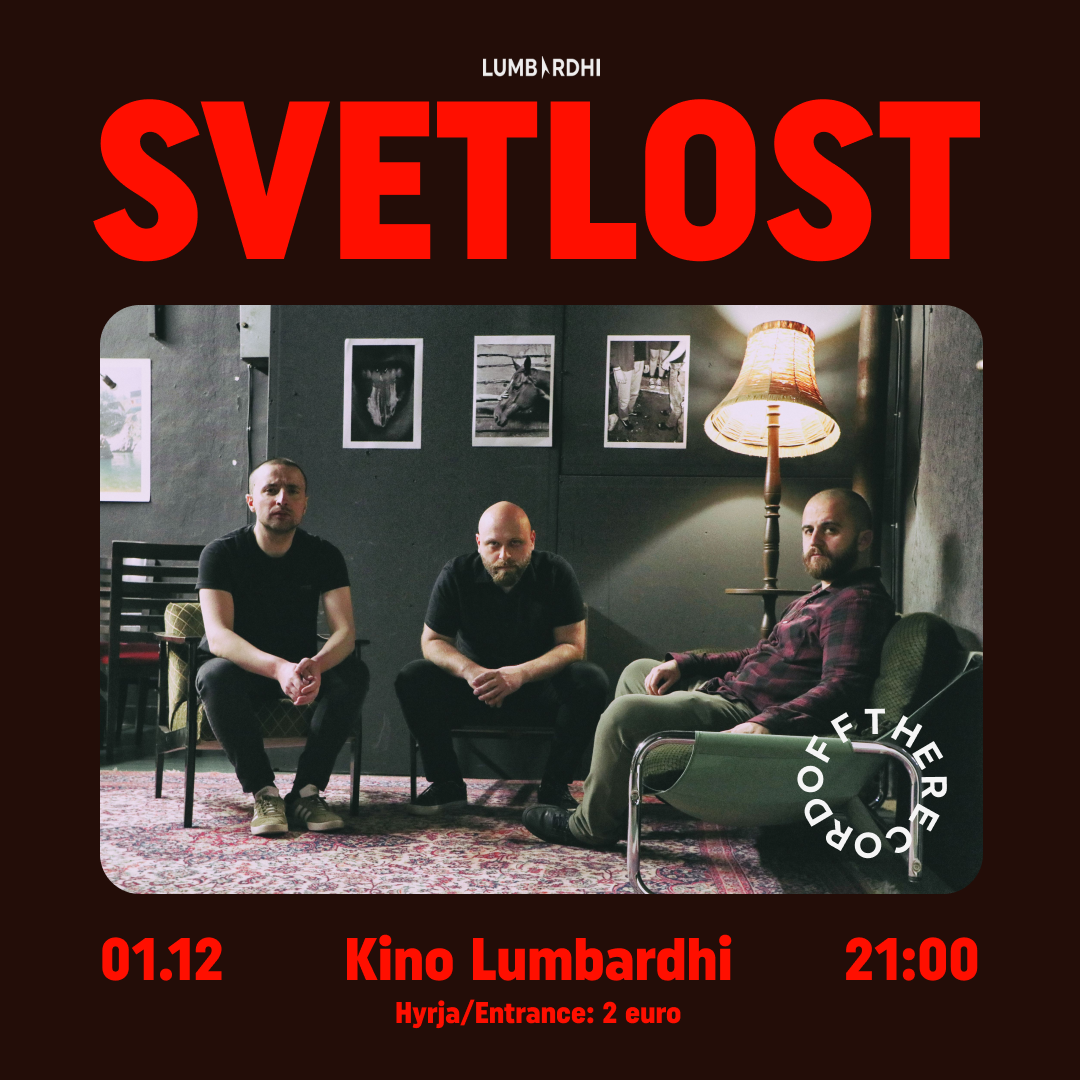
How do we cope with winter? With music. It could be a way.
We have turned this way of softening the cold season into a music program since 2023, inviting various local and international artists to use the Kino Lumbardhit spaces for experimental music.
This time, Off the Record returns at the beginning of December with the trio from Skopje known as Svetlost. Svetlost is an important jazz group in North Macedonia and their music is characterized by energetic, strong and complicated rhythms. The members of the band Svetlost formed in 2014: Kristijan Novkovski (drums), Deni Omegarić (bass) and Ninoslav Spirovski (clarinet/saxophone) create an elegant musical amalgam with dark, punk and depraved undertones. Svetlost's music has received international accolades and contains dark elements, narrating despair and sadness between the rhythms and forms of jazz, modal and psychedelic.
They will come to Kino Lumbardhi with their latest album entitled "Everything was and it had been a minute ago" co-produced by PMGJazz and Inverted Spectrum Records which contains habits and experiences of personal losses and daily social efforts of trios. In this appearance they will be accompanied by the violinist and composer Gligor Kondovski.
Previously, Edona Vatoci, Viola Rrecaj, Agona Shporta, Tringa Sadiku, Blla Blla Blla.. (Toka Shitet), Jazzair't, Cats Quartet, Elise and Ägain were part of this program.